
Artificial Intelligence in business: how to transform business processes into a competitive advantage
Artificial Intelligence is now at the center of many companies' strategic conversations, often presented as a revolution capable of radically changing the way we work. However, amid enthusiasm and high expectations, many organizations struggle to translate this potential into concrete results. The reason is simple: AI, alone, does not generate value. It is conscious integration into processes companies to make a real difference. In this article, we explore how to adopt Artificial Intelligence effectively, starting from what really matters: processes, data and business objectives.
Why should AI start from business processes?
When introducing a new technology, the temptation is to experiment quickly, perhaps making AI tools available to the entire organization. This approach, however, can be more confusing than good.
Without clear direction, the risk is to create real 'black holes' of productivity: repeated activities, outputs that are difficult to control and a loss of consistency in workflows. Business processes exist precisely to avoid this scenario, ensuring control, quality and traceability.
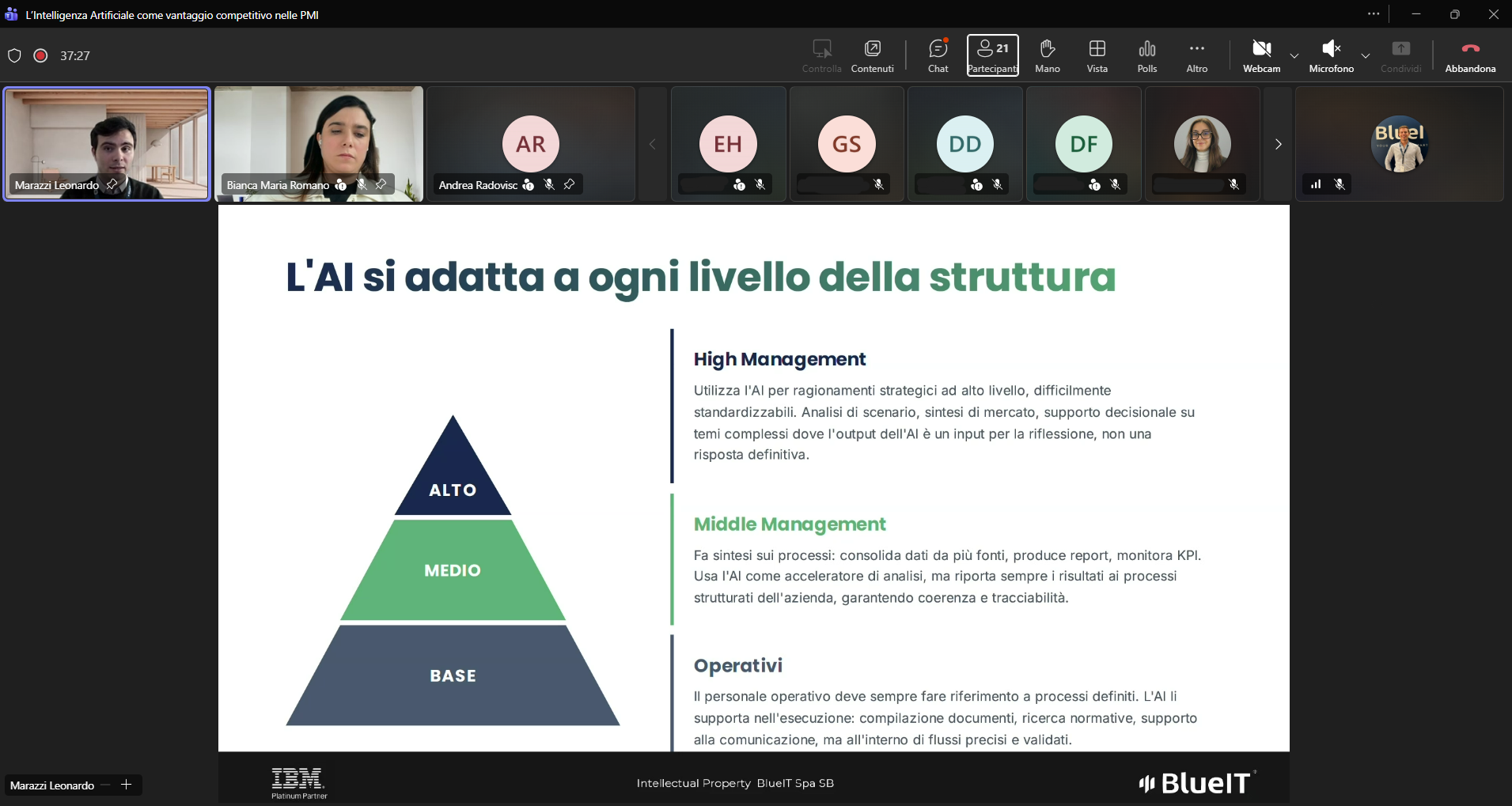
For this reason, Artificial Intelligence must be designed to adapt to existing processes, not the other way around; only in this way is it possible to maintain a clear operating logic, avoiding errors and ensuring that every activity remains under control.
Integrating AI means, therefore, inserting it into structured flows, where every action is traceable and linked to other business systems, such as ERP, CRM or management platforms. In this way, AI does not become an isolated element, but a real enabler of efficiency.
Practical applications of Artificial Intelligence
One of the most effective ways to get started is to focus on concrete, rapidly deployable applications.
The so-called “low-hanging fruits” make it possible to obtain tangible results in a short time, creating value right away:
- Document Intelligence: document management is one of the most common and at the same time the most time-consuming activities. Invoices, bills, certifications, and other documents often require manual entry and repetitive verification. Generative AI makes it possible to automate this process, recognizing and interpreting information regardless of format or position in the document. This means drastically reducing manual labor, increasing precision and freeing up resources from activities with low added value.
- Sales Assistant: in the commercial world, time is a critical resource. Often, teams spend a large part of their energy on operational checks, such as product availability or offering configuration. AI can act like an intelligent assistant, able to read customer requests, interpret them and quickly propose the most suitable solution. This not only speeds up response times, but also increases the quality of proposals, improving the chances of success.
- Knowledge Management in the factory: in many production settings, business know-how is concentrated in the most experienced people. This represents a risk, especially in situations of high turnover. Artificial Intelligence makes it possible to digitize this knowledge, transforming it into resources accessible to everyone. Through virtual assistants, new operators can be guided step by step through procedures, technical sheets and training materials, reducing learning times and improving overall efficiency.
Data security as a strategic priority
When it comes to Artificial Intelligence, one central theme cannot be ignored: data management. The true value of a company lies in its know-how, that is, in the way it manages processes, information and relationships. Entrusting this data to uncontrolled systems can pose significant risks, especially if the information is used to train external models.
For this reason, it is essential to choose solutions that guarantee the full sovereignty of the data. Companies must be able to maintain total control of their information, with the ability to manage solutions even in protected environments that comply with their policies.
Security is not a technical detail, but a strategic element that determines the success or failure of an Artificial Intelligence project.
A concrete path to adopt AI
One of the most common mistakes is to approach the adoption of AI as a long and complex project. In a rapidly evolving technological environment, this approach risks becoming obsolete even before it brings results.
The most effective strategy, on the other hand, is to proceed step by step, with a guided and results-oriented path.
Un structured approach allows you to:
- Analyze the current state of the company with respect to AI
- Identify the most relevant use cases
- Deepen internal processes to identify areas of greatest impact
- Test real solutions using company data in total security
This type of course allows you to move quickly from theory to practice, obtaining concrete results in a few weeks.
Conclusion
The goal is not to replace human work, but to empower it. Artificial Intelligence thus becomes an accelerator capable of improving what the company already does well, increasing speed, consistency and quality of results. That's exactly what we talked about in IBM webinar, of which we were guests and where we explored how to concretely integrate AI into business processes and obtain measurable benefits right away.
If you want to transform AI into a real competitive advantage, the right time to start is now: start with processes, test concrete solutions and measure the impact on your business.
Contact us and book an appointment now to find out how to apply Artificial Intelligence to your business reality and see up close the results on your processes.
.png)

The most popular articles
Discover the latest news and trends
(1).png)
(1).png)