
Beyond the use case: how to bring AI into production and generate value for companies
Artificial Intelligence offers new opportunities to simplify tasks, support decision-making, and improve business processes. But there is a significant difference between experimenting with a technology and concretely integrating it into daily work: this is where its true value is measured.
This reflection was the starting point for “Beyond the Use Case – AI that generates impact in production”, the BlueIT event held on October 22, 2026, in the stunning setting of Villa Arconati. It was a day of discussion dedicated to a central question for companies: how to transform the potential of artificial intelligence into usable solutions that are integrated into processes and capable of producing measurable results.
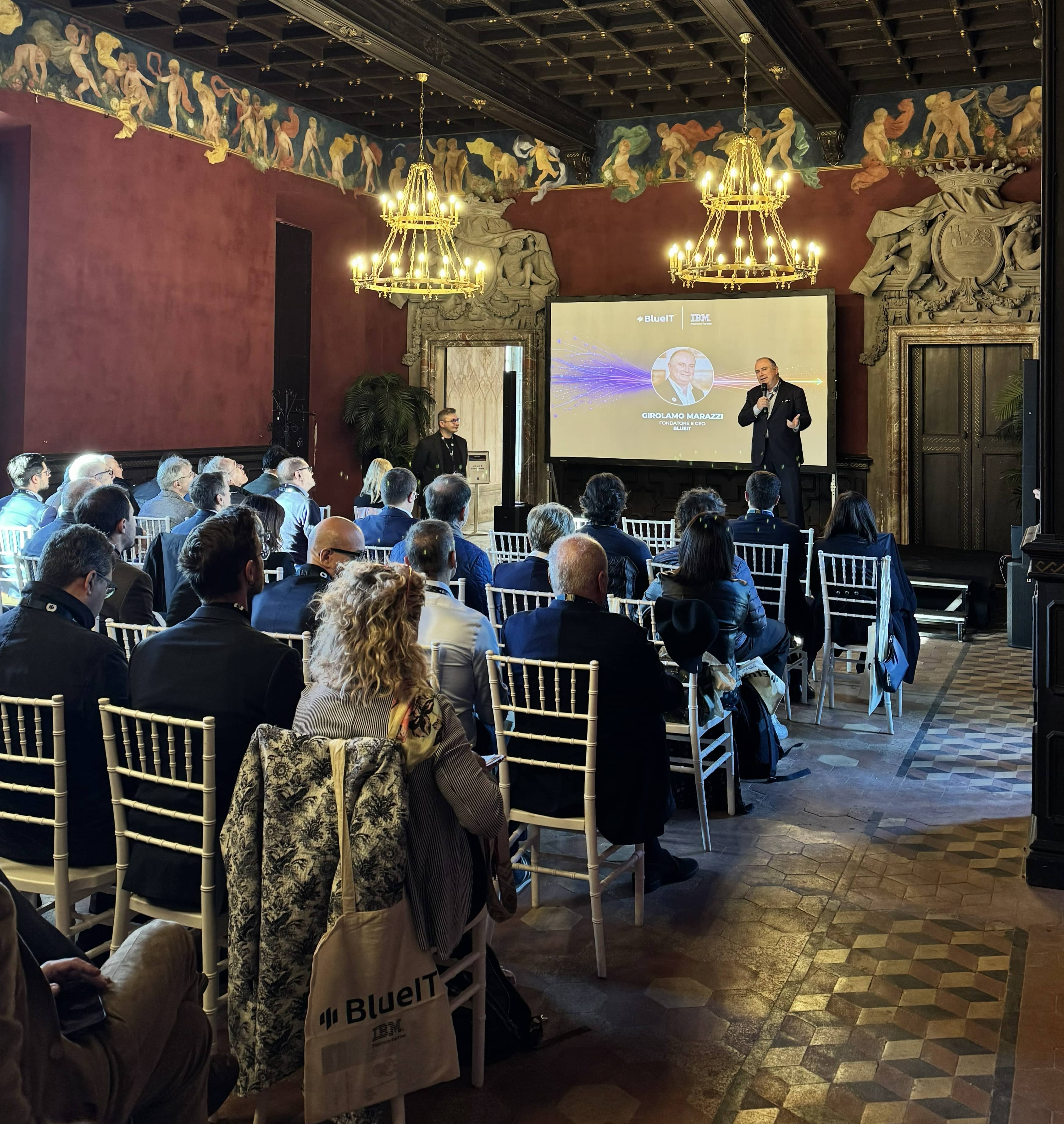
AI in the enterprise: from experimentation to production
Adopting artificial intelligence is not just about introducing new tools. To generate value, you must start with the company's needs, identify the activities where there is room for improvement, and understand how to integrate AI into existing workflows.
During the event, sessions dedicated to the evolution of AI and its impact on business helped frame this challenge, focusing on the transition from experimentation to concrete application. The topic concerns not only what technology is capable of doing, but also the conditions necessary to use it effectively: data availability, integration with corporate systems, reliability of results, and employee engagement.
Bringing AI into production means building a solution around a real problem. It means defining a goal, verifying that the application meets operational needs, and measuring its impact. It is a progressive journey that allows you to start with a specific use case and evaluate how to scale it once the results demonstrate the solution's value.
Artificial Intelligence applied to business processes: sales, procurement, and warehousing
The transition from theory to practice was the focus of three roundtables dedicated to three key business processes: sales, procurement, and warehousing. These are different areas, yet they share common ground: manual tasks, information scattered across multiple sources, and operations where Artificial Intelligence can help simplify the work.
- AI for sales - Managing requests and preparing quotes: preparing a commercial quote can be time-consuming, involving reading requests received via email, interpreting documents and attachments, searching for codes and price lists, and compiling the final document. AI can support this process by interpreting requests, extracting relevant information, and preparing a draft quote based on company data. The salesperson retains control, verifies the result, and approves the submission. The goal is to reduce administrative work and dedicate more time to customer relationships and higher-value activities.
- AI for procurement - organizing supplier information: procurement management requires collecting and using supplier information to support evaluation and supply management activities. Artificial Intelligence can help organize data from different sources, making it easier to consult and helping people access the information they need for their evaluations.
- AI for warehousing - automating the reading of delivery notes: when managing incoming goods, manually verifying delivery notes (DDT) and comparing them with orders can be time-consuming and create bottlenecks. An AI-based solution can analyze the digital delivery note, compare the information with the associated order document, and suggest matches. The operator verifies the results and validates the lines based on the relevant confidence levels, maintaining control over the process.
These examples show that AI does not necessarily have to transform an entire process to produce a significant improvement. Sometimes, intervening in a single task—such as interpreting a request, gathering data from different sources, or comparing documents—can simplify a broader workflow. The point is to identify where operational difficulties are concentrated and design a solution that fits into the process without adding complexity. This is how a single use case can become the starting point for a wider evolution.

How to bring AI into production: data, integration, and people
To transform an experiment into a truly effective Artificial Intelligence solution, a promising use case is not enough: you need reliable data, integration with corporate systems, and active involvement from your people.
AI can support and automate various activities, but human oversight remains essential. In the sales process, for example, staff verify the quotes generated by AI, while in the warehouse, they validate the matches between delivery notes and orders. This approach combines automation with supervision, maintaining control over the results.
To measure the value of the solution, it is important to define clear objectives, such as reducing processing times, manual tasks, and errors. A pilot project allows you to verify results using real data and evaluate whether to extend the solution to other processes.
Finally, AI must be integrated into daily activities and meet the needs of those who use it. Bringing AI into production therefore means combining technology, processes, and people, transforming the potential of artificial intelligence into concrete, measurable, and sustainable solutions.
Beyond the use case: let's build your AI adoption journey together
The event provided an opportunity to delve into a conviction that guides BlueIT's approach to Artificial Intelligence: value does not come from technology itself, but from its ability to tangibly improve the way people work. Every company has specific processes, data, and goals. For this reason, the path to AI in production starts with listening to needs, identifying the most suitable opportunities, and defining measurable objectives.
Do you want to understand which business process to start with or evaluate an Artificial Intelligence use case for your organization?
Contact us and let's discuss your company's needs to identify the best applications for turning the potential of Artificial Intelligence into concrete results.


The most popular articles
Discover the latest news and trends