
AI in Action: how to transform Artificial Intelligence into tangible value for business
Artificial Intelligence is evolving at an unprecedented pace: while many organizations continue to observe its development from afar, others are already transforming this technology into a driver of growth, innovation, and efficiency. This was the central theme of “AI in Action: practical innovation for business”, the event held on June 10, 2026, at the Saint Georges Premier in Monza in collaboration with AWS and Computer Gross.
A strategic gathering that brought together some of the key players in the digital ecosystem to analyze how AI is moving from the experimentation phase to real business application, the opportunities offered by AI, the main obstacles to adoption, and strategies to transform this technology into a real competitive advantage. From GenAI to Agentic AI, and even managing the risks associated with Shadow AI, a clear message emerges: the time to act is now.
Why businesses can no longer afford to wait
Today, businesses are facing what experts call the “AI paradox”: technology is advancing faster than organizations' ability to adopt it.
In this scenario, postponing doesn't mean standing still: it means accumulating what is known as technical debt, a strategic risk that can result in a loss of competitiveness compared to more innovative competitors.
To approach this change thoughtfully, during the event, some of the main myths still hindering the adoption of Artificial Intelligence in businesses were debunked:
- Myth 1: AI is too expensive - One of the most common fears concerns implementation costs: in reality, the transition from the testing phase to production can be managed sustainably through gradual scalability strategies. The recommended approach is to start with pre-trained, smaller models, thereby achieving predictable and easily plannable costs.
- Myth 2: Data is not secure - Security is one of the main concerns for businesses. However, it is crucial to distinguish between public and free tools and professional solutions designed for the enterprise context. Cloud Enterprise architectures allow operations with isolated models for each client and data localized in Italy, ensuring high standards of information protection.
- Myth 3: AI will replace human work - Artificial Intelligence does not eliminate entire professional sectors, but rather transforms the activities performed by people. The most repetitive and automatable tasks will be progressively delegated to intelligent systems, making room for activities with higher added value, creativity, and decision-making capabilities.
The new frontier: from Generative AI to Agentic AI
Technological evolution is accelerating towards increasingly sophisticated models; according to the vision presented by AWS, the value of generative AI develops across three fundamental dimensions:
- Creativity - through the generation of new content and ideas
- Productivity - by optimizing business processes
- Economic growth - with a significant impact on global development
It is therefore not surprising that by 2025, 60% of organizations have identified Generative AI tools as a top investment priority. The most advanced horizon is represented by Agentic AI, a new generation of systems capable of acting as autonomous collaborators, coordinating complex activities and processes through multi-agent models.
How to implement AI in your company without risks
Alongside technological aspects, the event highlighted the growing importance of responsible AI as an essential component of any adoption strategy.
Artificial Intelligence, in fact, is not just a technical tool but an element that directly impacts business decision-making processes. For this reason, organizations must address issues such as model transparency, explainability of decisions, bias reduction, and accountability for the results produced by AI systems in a structured way. Added to these is the growing attention to the energy sustainability of computing infrastructures.
Clear governance therefore becomes a prerequisite for ensuring trust, control, and scalability.
Risks and Challenges in Adopting Artificial Intelligence
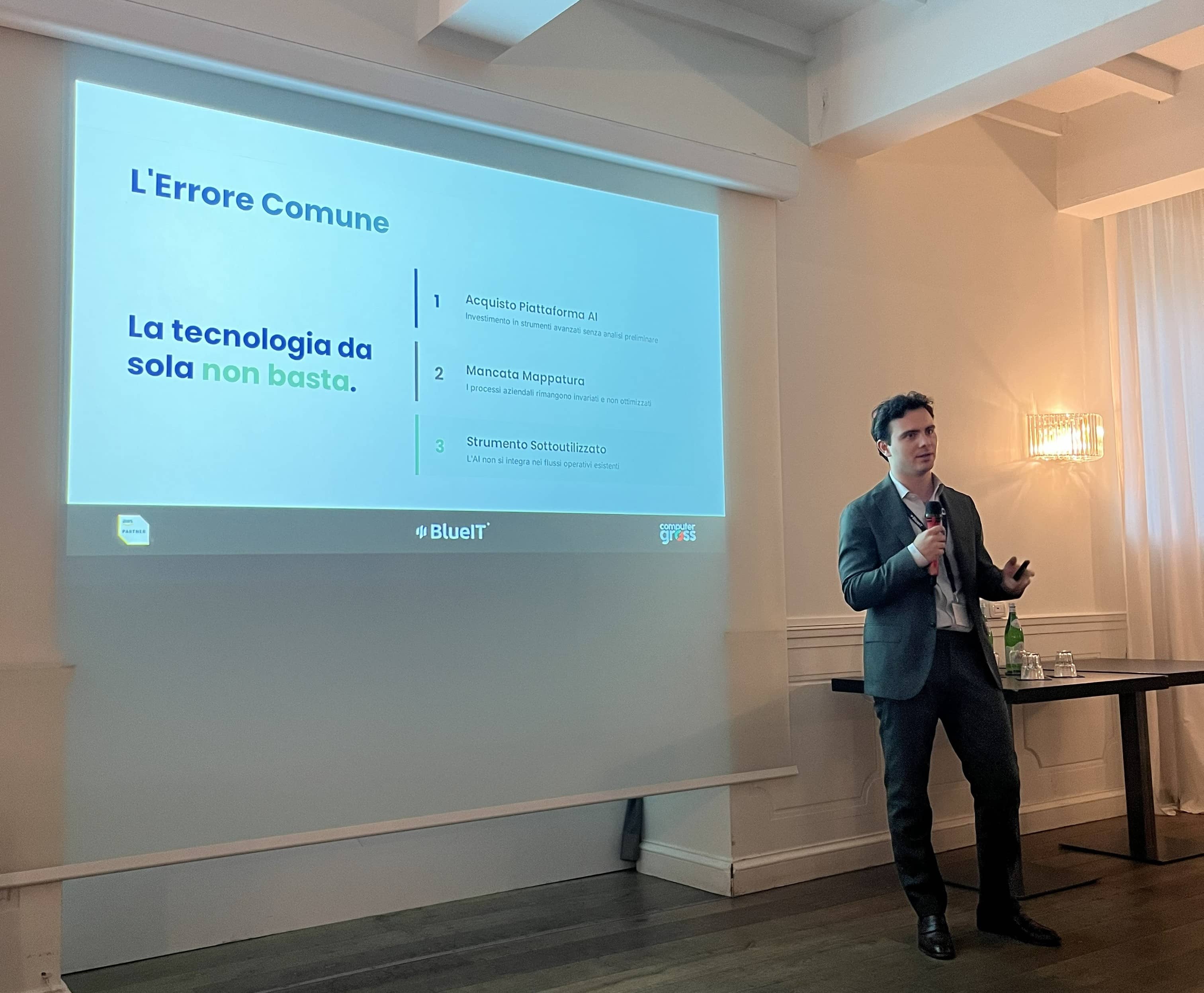
One of the most tangible issues that emerged during the event was the growing risk of so-called Shadow AI, which refers to the ungoverned use of Artificial Intelligence tools by employees without guidelines, controls, or adequate security measures. To address this challenge, BlueIT presented an operational framework designed to guide companies towards aStructured AI adoption. The goal is to build effective governance capable of mapping processes, systems, and people involved, transforming innovation into a secure and sustainable competitive advantage.
A successful integration rests on three key pillars:
- Secured Data: security as a priority
Protecting corporate information assets is the primary requirement for any Artificial Intelligence project. That's why it's crucial to move away from consumer tools and adopt Enterprise Cloud architectures designed to ensure data isolation, access control, and maximum security. - Clear objectives and measurable results
AI adoption cannot be limited to the 'wow' factor or innovation for its own sake. True value emerges when technology is applied to the company's core processes with defined objectives and measurable KPIs, capable of generating a concrete impact on the business. - Rapid experimentation and immediate return
The traditional approach based on lengthy transformation plans is giving way to a more agile methodology. The most innovative organizations develop vertical use cases that can be implemented in approximately 60 days, rapidly validating results and accelerating return on investment.
In this way, Artificial Intelligence stops being just a technological promise and becomes a concrete tool to improve business efficiency, productivity, and competitiveness.
The time to act is now
The history of innovation teaches us that every major technological revolution has transformed the way we work and create value: from printing to electricity, from personal computers to the Internet, and now to the Cloud. Today, Artificial Intelligence represents the new standard for operational efficiency.
Companies that can integrate it through solid infrastructures, rigorous data governance, and a results-oriented strategic vision will be able to transform it into a tangible asset, capable of generating measurable value quickly. The question, therefore, is no longer whether to adopt Artificial Intelligence, but how quickly you can transform it into a real advantage for your business.
If you want to understand how to apply AI to your business — from operational processes to data analysis, and the automation of repetitive tasks — we can help you build a tailored path. Contact us to learn how to adopt AI in business in a concrete, effective, and sustainable way and transform it into a real growth engine.
.png)

The most popular articles
Discover the latest news and trends
(1).png)

(1).png)