
AI Accelerator: how digital sovereignty is redesigning the adoption of Artificial Intelligence in the company
On April 22, the fourth edition of our AI Accelerator was held, a moment of discussion dedicated to one of the most strategic issues for contemporary companies: the adoption of Artificial Intelligence in a context of digital sovereignty, data security and hybrid architectures.
The initiative, carried out together with technology partners such as IBM and Computer Gross, offered a concrete vision on how organizations can accelerate digital transformation while maintaining control, governance and regulatory compliance.

Digital sovereignty and corporate AI: a new balance
One of the central themes that emerged during the event is that of digital sovereignty, understood as the ability of organizations to maintain full control over data, infrastructure and Artificial Intelligence models.
This scenario includes the concept of sovereign AI, which represents a design approach in which the company autonomously decides where and how to operate the AI, without binding dependencies on individual suppliers or platforms.
This paradigm allows businesses to more consciously manage access to sensitive data, choose between cloud, on-premise or hybrid environments, and strengthen the internal governance of AI processes. The result is a reduction in the risk of technological lock-in and greater resilience of digital architectures.
Hybrid architectures and open AI: the technological perspective
During the event, the role of open and interoperable architectures emerged strongly as an enabler for the adoption of AI on an enterprise scale. Solutions such as IBM watsonx, Red Hat OpenShift and IBM Storage Scale represent a technological ecosystem that allows Artificial Intelligence to be brought directly to where the data resides, without compromising in terms of security or compliance.
This vision reinforces a key principle: AI should not be confined to a single platform, but integrated into a flexible, observable and governable infrastructure.
Ethics, Governance, and Responsibility of AI
Alongside the technological aspects, the event highlighted the growing importance of responsible AI as an essential component of any adoption strategy.
Artificial intelligence, in fact, is not only a technical tool but an element that directly affects business decision-making processes. For this reason, organizations must address in a structured way issues such as model transparency, explicability of decisions, reduction of biases and accountability for the results produced by AI systems. Added to these is the growing attention to the energy sustainability of computing infrastructures.
Clear governance therefore becomes a prerequisite for ensuring trust, control and scalability.
Risks and Challenges in Adopting Artificial Intelligence
During the comparison, the main risks associated with the adoption of AI in complex business environments were also analyzed.
These include the difficulty of integrating AI models with legacy systems, the possibility of obtaining unverifiable outputs, regulatory and reputational implications, in addition to Vulnerabilities related to cybersecurity. Added to these elements is the theme of the increasing energy consumption of AI models, which requires reflection also in terms of infrastructure sustainability.
The most effective approach is therefore not that of rapid and ungoverned adoption, but of a progressive and controlled path.
From Technology to Value: Rethinking Business Processes
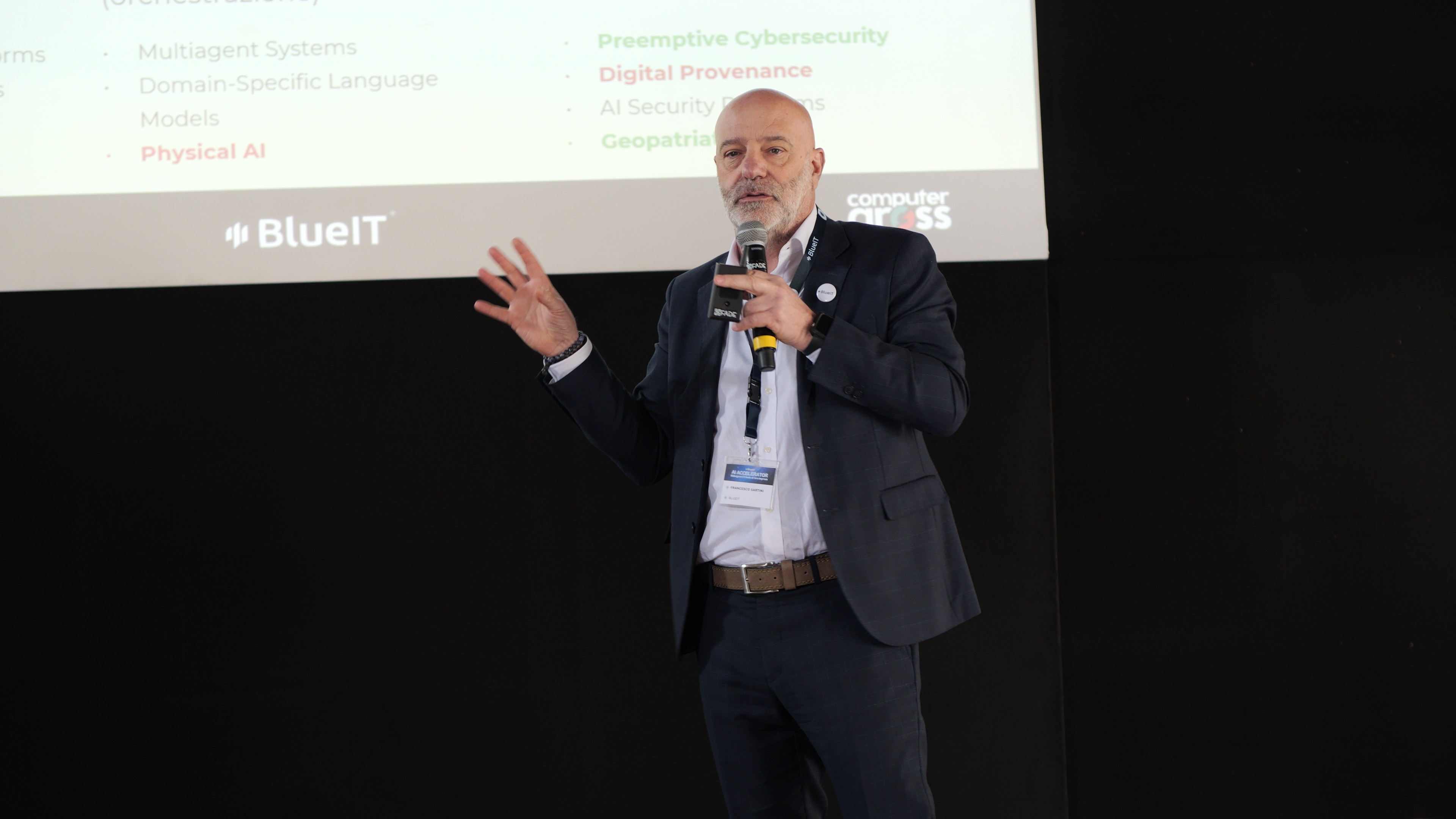
The comparison highlighted some evolutionary directions that are already influencing companies' strategies at a global level: these include the development of AI-native platforms, the adoption of multi-agent systems, the evolution of confidential computing and AI security platforms, up to the emerging themes of the digital origin of data and post-quantum cybersecurity. These trends help to redefine the way in which organizations design, protect, and scale their digital infrastructures.
One of the key messages of the AI Accelerator was clear: the value of Artificial Intelligence does not derive from its simple implementation, but from its conscious integration into business processes. To obtain concrete results, it is necessary to start from the analysis of existing processes, identify inefficiencies and bottlenecks and then redesign operational flows integrating AI where it can generate real value.
Only through this approach does Artificial Intelligence become a strategic and measurable enabler. In this context, several use cases that generate immediate value in business processes find concrete application: from Document Intelligence, which automates document management and supports regulatory compliance, to Sales Enablement solutions based on AI assistants that improve business interactions and reduce response times, to Knowledge Management, which transforms company repositories into dynamic and interrogable systems, making knowledge more accessible and contextual.

The Future of Enterprise AI
The AI Accelerator event on April 22 highlighted a clear vision: the future of Artificial Intelligence in companies is based on three fundamental pillars.
Digital sovereignty guarantees control and autonomy over data, open architectures ensure flexibility and interoperability, while ethical and responsible governance allows us to build trust and sustainability over time. This shows how AI is not only a technological evolution, but a real engine of strategic transformation for companies.
Discover our digital transformation services
Digital transformation, the adoption of Artificial Intelligence and the management of data sovereignty require appropriate skills, strategy and technologies.
If you want to understand how to apply these principles to your organization and build a secure, scalable and compliant digital ecosystem, we can support you every step of the way.
Contact us and build with us your digital transformation strategy based on AI and data security.
.png)

The most popular articles
Discover the latest news and trends
(1).png)
.png)
(1).png)